I’ve got a problem that I couldn’t figure out how to oversee and/or ignore since a good while now, spreading advice based on a poor unilateral interpretation of the Academic Literature.
Anyone with a decent knowledge/background in Statistics is very well aware of how hard it is to approach a scientific problem, be it social, psychological, physiological, or otherwise any other field that people tend to feel the need to explore in order to make their life less miserable and more efficient by understanding more about the problem.
In our daily life, we see posts/articles/people recommending some food as “healthy”, or an ‘X’ hours of daily sleep as “the optimal” for the best cognitive performance and functioning. The Dietary and Somnology fields are probably the most common topics in which you’re likely to find people provide advice, all the time!
Few of the reasons that I can think of may be that these two fields are one of the hardest fields to study due to the amount of confounding variables, hard replicability, and poor reliability and validity of their research literature.
Let’s take an example of that. I was having a discussion on the sleep debt and the effects of sleep deprivation on the short and long term. During the discussion, the following study was sent to me as a proof of an optimal amount of hours needed to “maintain cognitive functionalities in humans” (quoted because of how ambiguous this statement reads). The paper published in 2020, titled “Mild to moderate partial sleep deprivation is associated with increased impulsivity and decreased positive affect in young adults“.
From reading the title, one can jump to the conclusion that “sleep deprivation is associated with a decrease in cognitive functioning in young adults”, which also makes a great material on those “health” outlets or newspapers. Some of the questions that popped up once I read the article are, how accurate this study is and how reliable and valid the results are, and to what significant and certain extents it is conclusive. After reading the paper, my conclusion is that the study isn’t in anyway accurate, poor reliability and validity. I can argue with a moderately high degree of certainty that it’s poorly replicable, and definitely not conclusive.
Here are my reasons as of how I reached to that conclusion:
1- This is a naturalistic study, that type of studies unintentionally incorporates lots of external and sometimes unknown biasing factors, some of which are confounding, with a very low possibility of being capable of eliminating the majority of them that are known under and based on the mentioned environment setup.
2- Sample Size is too low to draw any significant insights, 52 sample size is definitely not big enough to imply anything conclusive on a large population, large enough to treat it as a universal RI.
3- Experiment duration problem. 11-days study is a very short period of time, constituting of 7 days of habitual sleep first, after that sleep hours were decreased by 2 hours for 3 nights, then results were observed.
4- Biasing/Confounding variables. A lot of Academic work exist on the effect of food on the body that could continue up to a month, which makes a fair minimum duration for any physiology-related experiment to be 4 weeks, considering a strictly controlled and monitored diet and food intake to eliminate this hugely biasing factor. Another factor is the Geographical variance, which is a factor that contributes to sleep and varies between individuals located in different geographical locations in the world because of climate, diet, and day/night cycles to name a few in that part.
5- Actigraphy, while being a decent methodology used in Somnology as per previous studies, it has downfalls, some of which could be too significant to include false positives (wake periods interpreted as sleep periods, and vice versa).
To conclude the example, and in my own opinion, the paper is as precise as its limited scope so far.
Now moving to a recent (and decent in my opinion based on the following reasons) previous work, the 2014 study “The complexities of defining optimal sleep: Empirical and theoretical considerations with a special emphasis on children“.
To be fair, both papers couldn’t be compared, as the former was an experiment, while the latter tries to address the clinical challenges and different aspects and concerns in the Somnology field. However, it was mentioned in this context as it addresses a number of variables, factors and challenges that are widely known and debatable within the Somnology community. For example, in the beginning it addresses the differences of defining “optimal sleep” between a number of previous work in the field.
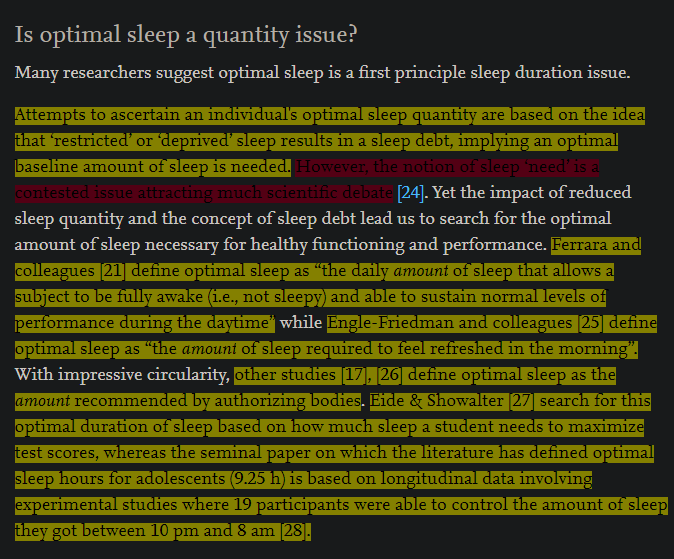
Then, it outlines few of the factors that contribute to the optimal sleep, and finally it concludes by stating that there are lots of terms that of which the definitions need to be unified and agreed on, and questions that need to be further explored, studied and hopefully answered with a decent amount of certainty and conclusiveness.
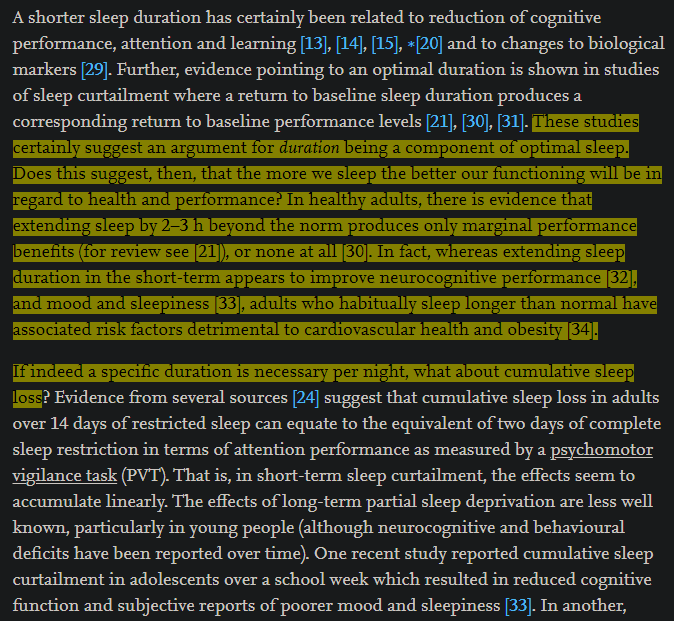
Back to the main topic of the post, these two examples shed light on how hard naturalistic and field studies are, and that a single universal conclusion is definitely not there yet, and personally I don’t see anything of that sort coming up soon because of how complex such topics are, and how much of and in them we still do not know, and can’t figure out unless maybe drawing some noticeable observations through frequent experimentation over the span of a few years.
As a conclusion, it’s unlikely and (in most cases) scientifically not certain nor proven to find a universal recommendation that applies to everyone equally (if at all) in the topics of dietary nutrition and optimal amount of sleep. I really hope that people would one day stop spreading unproven and sometimes misinformed advice after reading a random article/watching a video that states “eating ‘X’ food is healthy, while ‘Y’ food is not” before articulately phrasing their own definition and scope of “health”.
Stay intellectually safe and healthy! 🙂
 The Art Of Superposition